
Introduction: Let the Guest Tell You What to Charge
Conventional advice for short-term rental owners often sounds simple: winter is peak season, so set your rates high in the fall and hold your ground. But looking closely at what guests actually do reveals a different story. Some travelers plan almost a year ahead, while others book winter trips with only days to spare.
To maximize profitability, successful property managers focus heavily on vacation rental pricing strategies, winter revenue management, and short-term rental market trends. Instead of forcing arbitrary pricing rules, let consumer behavior drive your decisions to optimize overall earnings.
Why Holding Out for Higher Rates Fails
A common argument suggests that discounting early gives away valuable dates. While selling a high-demand week too cheaply is a risk, a blanket “hold your rates” rule ignores the probability of securing a booking.
Properties in the same market, or even on the same street, experience vastly different search volumes and conversion rates. Managing properties effectively requires tracking RevPAR (revenue per available night) rather than obsessing solely over average daily rates (ADR). An unsold night earns zero revenue.
To explore more about dynamic pricing models and industry standards, you can review insights from PriceLabs or market intelligence from AirDNA.
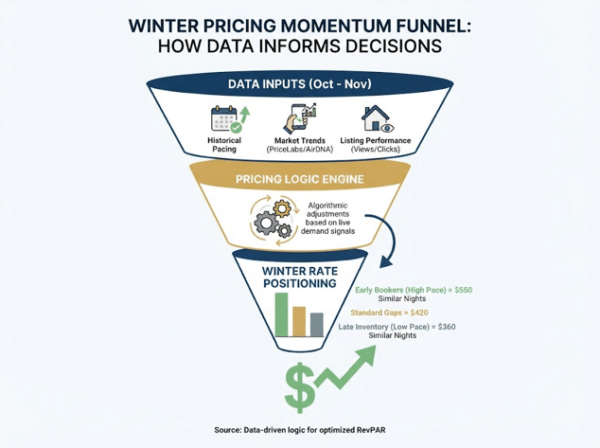
Building Momentum and Reading Booking Windows
Entering a busy season is about building momentum rather than protecting an arbitrary number. Key metrics like booking lead time and pacing help determine whether to raise or lower rates.
- Booking Lead Time: The duration between when a guest reserves and when the stay begins.
- Booking Pace: Measures how quickly future dates sell compared to previous periods.
When a listing under-performs, the issue isn’t always the price. Photos, amenities, minimum-stay restrictions, and cross-platform consistency all heavily impact conversion.
Market-by-Market Insights: Five Winter and Spring Destinations
Reservation data across distinct markets demonstrates that broad seasonal rules often fail.
Coachella Valley
Indio reveals two distinct buyer profiles. Festival-goers book nearly a year in advance for April events, whereas ordinary winter travelers often book close to check-in. Capturing both requires opening calendars early for planners while managing remaining gaps independently.
Scottsdale
Winter guests here book further ahead than summer visitors, but regional events like the Phoenix Open do not guarantee automatic bookings. Monitoring pace allows managers to adjust rates or minimum-stay requirements before windows slip away.
Fort Lauderdale
A nearly empty calendar months in advance can still yield strong results because of heavy last-minute demand. This market allows managers to hold out for top-tier rates longer before filling remaining gaps.
Anna Maria Island
Early bookings for spring serve as a signal rather than a blanket forecast for all remaining dates. Property features like waterfront access and outdoor space dictate what guests are ultimately willing to pay.
Las Vegas and Henderson
Broad seasonal pricing fails here because summer and winter performance can match, while specific convention dates command premiums. A convention calendar is a clue, but your actual bookings are the evidence.
Conclusion: Maximizing Short-Term Rental Profitability
Ultimately, successful winter revenue management relies on listening to consumer demand. Stop asking what your winter ADR should be and start evaluating what the entire calendar can realistically earn. By monitoring lead times, tracking market signals, and refining listing quality, property owners can optimize their vacation rental pricing strategies to maximize yearly revenue.
“We don’t need to tell guests when they ought to book or what they ought to pay. They’re already telling us what they want, every time they book—or don’t book—a property.” — FIBI Vacation Rentals
Frequently Asked Questions
- Should I lower my winter Airbnb rates in October if I don’t have many bookings? Compare today’s reservations against normal pacing. If demand lags behind expectations and the usual booking window is passing, act early.
- Does taking an early discounted reservation hurt future prices? It commits specific nights at that price, but it does not establish a permanent valuation for your property. Balance the risk of discounting too early against the risk of earning zero.
