This case study analyzes the impact of targeted revenue management interventions on a portfolio of 31 short-term rental (STR) properties in the Houston metropolitan area, including Galveston and the Bolivar Peninsula.
The objective was to evaluate whether a disciplined approach to pricing and booking policy optimization could generate positive year-over-year (YoY) revenue growth in a market experiencing overall declines.
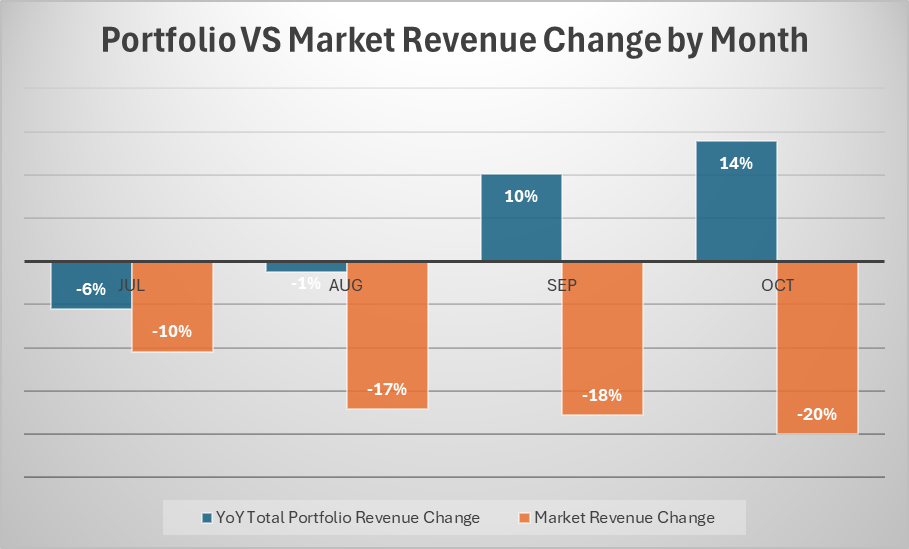
Over a 3-month control period beginning August 8, 2025, the management team at FIBI Vacation Rentals implemented a structured pricing and booking policy framework across the portfolio. The findings demonstrate that the portfolio achieved YoY revenue increases of up to 14%, while the broader Houston STR market declined by as much as 20% during the same period.
In early Q3 2025, our team was contracted to assume revenue management responsibilities for 31 STRs in the Houston metro area. Of these, 24 properties had at least one full year of operational data, allowing for direct YoY comparisons.
The Houston STR market had been in visible decline for much of 2025. Data from AirDNA and other market tracking tools indicated YoY drops in RevPAR (Revenue per Available Night) ranging from 10% to 20% through mid-year. Our goal was to determine whether the application of our revenue management methodology could not only mitigate these losses but reverse them.
In the context of STR operations, revenue management refers to the strategic control of nightly pricing and booking parameters to maximize occupancy-adjusted revenue.
The primary lever is price — determining the optimal nightly rate to advertise based on demand, seasonality, and competitive context.
However, several secondary levers contribute to booking conversion rates and profitability. These include:
While our service offering also includes OTA (Online Travel Agency) SEO optimization, this variable was deliberately excluded from the analysis period to isolate the effects of rate and policy adjustments.
| Date | Intervention | Description |
|---|---|---|
| August 8, 2025 | Initiation | Began active nightly rate management for all properties |
| August 8–31, 2025 | Policy Review | Reviewed and advised owners on booking policy restrictiveness; implemented recommendations |
| October 2025 | SEO Phase Initiated | Began listing-level SEO improvements; data for this period still pending |
This timeline ensured that the measured outcomes in September and October primarily reflected pricing and booking policy adjustments, without contamination from SEO or design interventions.
| Month | Portfolio YoY Change | Market YoY Change (RevPAR) |
|---|---|---|
| July | -6% | -10% |
| August | -1% | -17% |
| September | +10% | -18% |
| October | +14% | -20% |
The data reveal a clear divergence between the managed portfolio and the broader market.
While Houston-area STRs experienced consistent double-digit declines, the managed portfolio reversed its trajectory and began outperforming the market by as much as 34 percentage points by October.
| Month | Change in Revenue (YoY) |
|---|---|
| July | -$4,638.21 |
| August | -$848.07 |
| September | +$6,538.82 |
| October | +$9,158.43 |
| November (through 5th) | +$5,276.42 |
Cumulatively, this represents a positive swing exceeding $25,000 across the same 24-property cohort in just three months.

The Houston STR market, and particularly coastal submarkets like Galveston and Bolivar, faced significant demand compression in 2025.
Seasonal peaks remained strong, but off-season bookings weakened substantially — with reports showing occupancy rates down 10–20% year-over-year and ADRs (average daily rates) under pressure from oversupply.
In this environment, outperforming the market by double digits was not merely a function of brand or design — it was achieved through systematic, data-based control of the two most influential levers available to STR operators: pricing and booking policy flexibility.
Dynamic Rate Adjustments:
Rates were recalibrated daily based on booking pace, local event calendars, and market compression signals.
Reduced Booking Friction:
Transitioning from inquiry-based to instant-book availability increased conversion efficiency and improved ranking in OTA search algorithms.
Shortened Minimum Stay Requirements:
Adjustments during shoulder periods increased occupancy without diluting ADR.
Collectively, these interventions expanded available booking opportunities and captured demand that competing operators were rejecting through overly rigid policies.
While performance gains were observed as early as September, the August data show minimal movement due to the two-week integration and calibration period. The systems and policy recommendations required owner cooperation and OTA synchronization before showing measurable results.
Additionally, the delayed initiation of SEO work means future analyses (December onward) may reveal further compounding effects as listing visibility improves.
This study isolates the impact of revenue management interventions but does not control for externalities such as:
Individual property quality or design improvements
Mid-stay maintenance events affecting availability
Localized weather events (particularly coastal properties)
Furthermore, while the sample size (24 data-comparable properties) is sufficient for directional insights, a larger control group could strengthen statistical confidence.
This case study provides empirical evidence that active, data-driven revenue management can not only stabilize but reverse negative revenue trends in declining STR markets
Between August and October 2025, our managed Houston portfolio experienced consistent month-over-month improvement — outperforming the market by a wide margin, with up to 14% YoY growth in a market declining 20%.
The findings reinforce a broader principle:
Dynamic rate control and reduced booking friction are among the most powerful, controllable drivers of revenue growth in short-term rentals — regardless of market conditions.
Further analysis will explore the interaction between revenue management and OTA SEO optimization, as those efforts have only recently begun. Early indicators suggest that combining these strategies can yield compounding improvements in both conversion rate and top-line revenue.
A comprehensive Revenue Management Course is currently in development to share the frameworks, formulas, and methodologies used in this study.
FIBI Vacation Rentals
For Investors, By Investors
📧 Contact Us
🌐 fibivacationrentals.com