
Self-Managed vs Outsourced STR Management: Which Is Better?
If you own — or are thinking about buying — a short-term rental, one of the first big decisions you’ll have to make is this:
Should you manage the property yourself, or hire a professional short-term rental management company?
There isn’t a universal answer. Both approaches can work.
But after years in this industry, managing dozens of properties across multiple markets, I can tell you that the decision usually comes down to two things:
- How much time you have
- How much knowledge and scale you bring to the table
Those two factors determine whether self-management is realistic — and whether it will actually maximize your profits.
Let’s break it down.
The Growth of Short-Term Rental Investing
Short-term rentals have exploded over the past decade.
Platforms like Airbnb, Vrbo, and Booking.com made it easy for homeowners to rent out properties to travelers, and a lot of investors jumped into the space.
Supply has grown rapidly — probably around 20% a year for several years in many markets.
Demand has grown too, but not always at the same pace. Some years demand outpaces supply. Other years supply grows faster.
But here’s the interesting thing I see over and over again when talking to property owners:
Even though average revenue per property is trending upward, many individual owners are seeing their revenue go down.
Self-Managed vs Outsourced STR Management. How does that happen?
Because the money is increasingly going to the top-performing properties.
A relatively small percentage of listings — maybe the top 20% of properties — are capturing a huge share of bookings.
Those are what I call “super properties.”
They have:
- better design
- better amenities
- better pricing strategies
- better operators behind them
And this trend matters a lot when deciding whether you should self-manage or outsource your STR management.
What Self-Managing a Short-Term Rental Really Means
When people say they’re “self-managing” their Airbnb, what they usually mean is that they’re handling the operations themselves rather than hiring a management company.
That includes things like:
- Creating and optimizing the listing
- Communicating with guests
- Coordinating cleaning and maintenance
- Managing pricing
- Responding to reviews
- Handling guest issues
- Staying compliant with local regulations
For one property nearby, this is often manageable.
If you have a single Airbnb in the same city you live in, and you’re not working 70 hours a week at another job, you can probably do it.
I see plenty of owners do that successfully.
In fact, some self-managing hosts are excellent at hospitality.
They take great care of their guests. They respond quickly. They get tons of five-star reviews.
That’s their competitive advantage.
But that’s also usually where the advantage ends.
The Knowledge Gap Most Self-Managing Hosts Don’t See
Even great hosts often miss something important.
They focus on guest service, but they don’t fully understand the revenue science behind short-term rentals.
And that’s where professional operators tend to outperform them.
At the end of the day, Airbnb and Vrbo are search engines for vacation rentals.
Before you can get a booking, your property has to show up in search results.
That requires understanding things like:
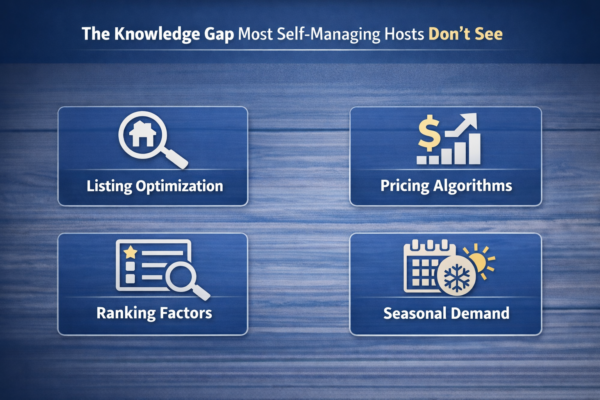
- listing optimization
- pricing algorithms
- platform ranking factors
- seasonal demand patterns
Most self-managing hosts don’t have the time — or the data — to really understand those things.
So even if they’re great hosts, they’re often leaving money on the table without realizing it.
I call that the ignorance tax.
If you don’t know how to maximize nightly rates or visibility, you simply earn less.
The Economies of Scale Professional Managers Have
The other major advantage professional STR operators have is scale.
When you manage dozens or hundreds of properties, several things happen.
First, software costs drop dramatically per property.
For example, many STR tools cost $25–$50 per listing. If you’re running one property, those costs add up quickly.
But when you’re running 50 or 100 properties, those costs get spread out across the entire portfolio.
What might cost a self-manager $200 per month in software might cost a large operator less than $10 per property.
Second, operators managing properties across multiple markets learn much faster.
When you operate in highly competitive markets — places like:
- Scottsdale
- Disney-area vacation markets
- Coachella Valley
—you see what the best properties are doing.
And what they’re doing can be wild.
We’re talking about:
- lazy rivers in backyards
- $150,000 game room conversions
- full movie theaters in basements
- massive amenity upgrades
When you compete against that level of inventory, it forces you to raise your game.
Then when you operate in less competitive markets, you bring that knowledge with you.
That’s a huge advantage.
Typical STR Management Fees
Most professional short-term rental managers charge somewhere between 15% and 35% of revenue.
Here’s how that typically breaks down:
- 10% managers (usually very limited service)
- 15% managers (often the sweet spot)
- 20–35% managers in higher-touch or luxury markets
In my experience, the cheapest managers tend to produce the worst results.
Running short-term rentals properly requires infrastructure:
- technology
- staff
- guest support
- pricing systems
- vendor networks
If a manager is charging too little, they often can’t afford to build that infrastructure.
And the property suffers.
Why Cheap Properties and Cheap Management Often Fail
One pattern I see over and over again in this industry looks like this:
Someone buys a property and treats it like a flip.
They think:
“Let’s spend as little money as possible so we maximize ROI.”
So they:
- buy a cheap property
- furnish it cheaply
- install builder-grade everything
Then they hand it off to a cheap manager.
Now you have a mediocre property being run by mediocre management.
The result is usually the same:
The property underperforms and eventually becomes unsustainable.
Short-term rentals are a hospitality business.
And hospitality businesses require investment.
Exceptional guest experiences require exceptional properties.
When Self-Managing an STR Makes Sense
Self-management works best in a few specific scenarios when talking about Self-Managed vs Outsourced STR Management.
For example:
- You have one property
- The property is close to where you live
- You have time available
- You enjoy hosting guests
In those cases, self-management can work well.
You might even outperform some management companies simply because you care deeply about the property.
When Outsourcing STR Management Makes More Sense
There are also many situations where hiring a professional operator is the smarter move.
For example:
- You don’t live near the property
- You have multiple properties
- You’re extremely busy with your career or business
- You want to maximize revenue in a competitive market
A strong operator can often increase revenue significantly.
I’ve seen it happen repeatedly. Self-Managed vs Outsourced STR Management
We’ve taken over dozens of properties where owners were earning one number — and after redesign, pricing optimization, and operational improvements, those properties earned double or triple what they were earning before.
That’s the knowledge gap at work.
Self-Managed vs Outsourced STR Management: The Hybrid Option
Revenue Management
There’s also a middle ground that many owners overlook.
If you’re a good host but don’t have expertise in pricing or listing optimization, you can partner with a revenue management service.
In that setup:
- You handle guests and operations
- A specialist handles pricing and listing optimization
These services are usually inexpensive — often around 3% of revenue — but they can dramatically increase performance.
If you’re self-managing, that’s often the highest ROI improvement you can make.
Final Thoughts: Self-Managed vs Outsourced STR Management
The decision between self-management and outsourced management ultimately comes down to three things:
Time. Knowledge. Scale.
If you have time, a nearby property, and you enjoy hosting, self-management can work well.
But if you want to compete at the highest level — especially in competitive markets — professional operators bring advantages that are hard to replicate on your own.
They have:
- data
- systems
- experience
- economies of scale
And in today’s increasingly competitive STR market, those advantages matter more than ever.
Self-Managed vs Outsourced STR Management
Resources
-
Hostaway – Airbnb Management Fees: A Complete Breakdown
https://www.hostaway.com/blog/airbnb-management-fees-a-complete-breakdown/ -
Baselane – Charging Yourself a Management Fee for Short-Term Rental Properties
https://www.baselane.com/resources/charging-yourself-management-fee-for-short-term-rental -
Hostaway – Breakdown of Short-Term Rental Management Fees
https://www.hostaway.com/blog/breakdown-of-short-term-rental-management-fees/ -
StaySTRA – Short-Term Rental Management Fees Explained
https://staystra.com/short-term-rental-management-fees/ -
Hostaway – Airbnb Simplified Pricing Guide
https://support.hostaway.com/hc/en-us/articles/4440625924763-Airbnb-Simplified-Pricing -
Hostaway – Airbnb Host-Only Fee Explanation
https://www.hostaway.com/blog/airbnb-host-only-fee-what-to-know-about-the-15-percent-host-fee/ -
Shosty – Short-Term Rental Management Fees
https://www.shosty.com/management-fees
